Jacquelyn pointed out this morning how odd it was to make a film photograph, develop the negative, and then turn around and digitise it. Amongst the film photography enthusiast community, this approach is known as hybrid photography, blending the use of film into the digital world. If I want to do anything with a photograph on the internet, then it is at some stage going to be digitised. I have opted for this blended approach to film as there is simply a massive amount to learn. First, I must learn to use large and medium format cameras and lenses. Then, I need to learn to develop film. And finally, I need to learn to digitise negatives and turn them into viewable positives. I could skip the learning to develop step; however, my school modules require the current week’s work to be submitted for classes, so if I am to be in a position to use any of my analogue photographs, I need to have a faster turnaround than mailing my exposed film to California and waiting for their return scans.
None of the above explains my desire to learn about film. I used to use film, and in my teens, I enjoyed photography. I used my family’s Pentax ME Super—it now sits dead on my shelf as a decoration. Its shutter sticks and two attempts to service it have not resulted in a reliable mechanism, so it has become a bookend. I returned to university for a graduate degree because I wanted to learn. I am not studying for a new career. I am studying to learn and expand my understanding of photography because it is a passion. Photography started as a chemical process, which evolved into what we now call film photography, and then, as technology allowed, photography entered the digital world. Returning to film, I combine history, science, composition and aesthetics lessons that could get skipped over if I only stayed in the digital world.
Film photography is an unforgiving process, but this is a positive. Once a negative is exposed, its resolution, grain, contrast and tonal range are set. The film does not store information the way a digital file from a DSLR does. The film chemically captures the light it receives and responds within a small range of chemical changes. The consequence is that if the exposure is too little, you end up with a dark image and will lose information, and if the exposure is too great, the highlights get blown out, and you lose the information there. The data is lost forever. Unlike digital images, where there can be tremendous hidden variation in the shadow data, the data is lost with film. The film stock (brand, type, speed) also affects how much analogue information is captured during the exposure. Some films work quickly and are suitable for low light; others require more light and take longer to (chemically) respond to the light, hitting the film.
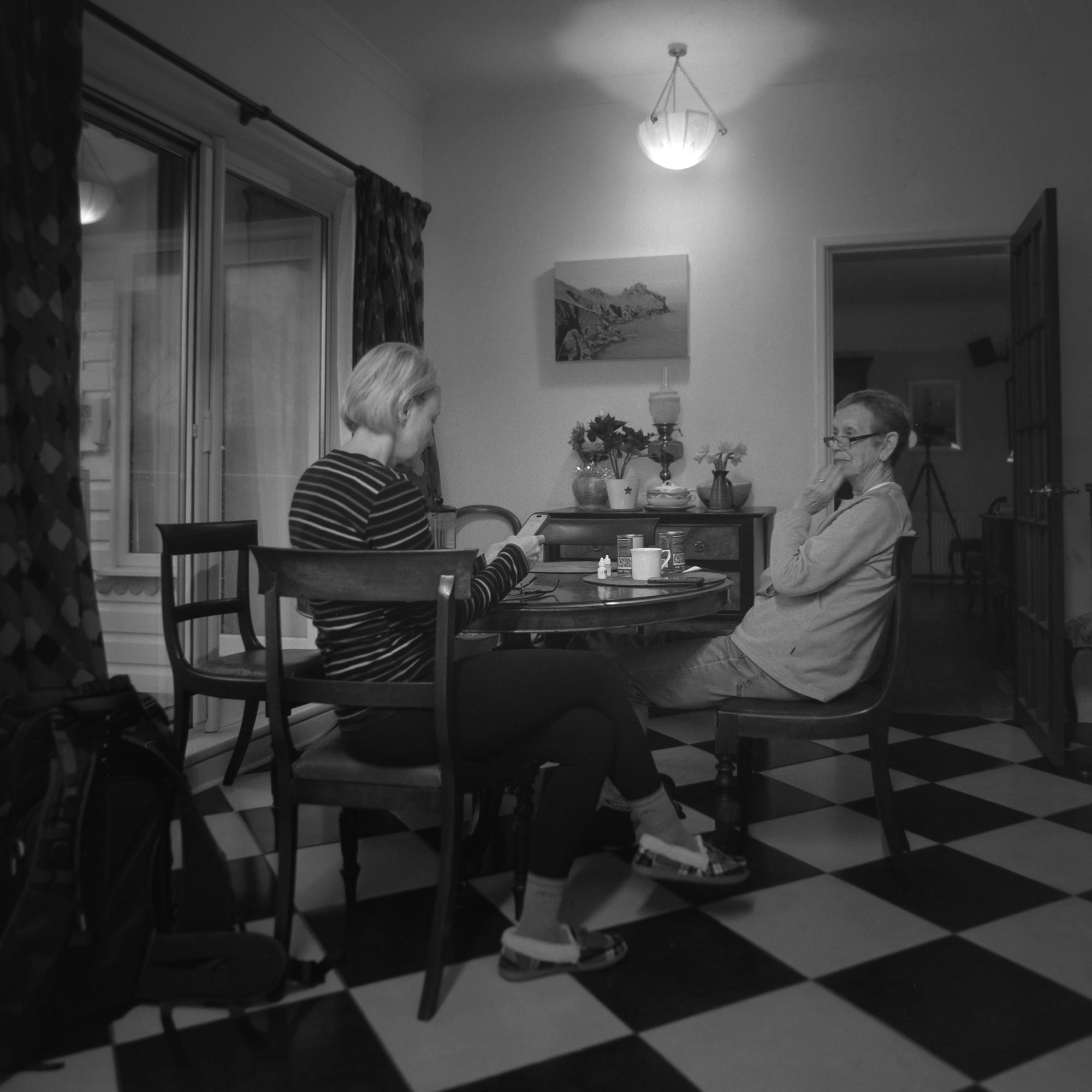
This photograph illustrates this responsiveness well. I made it handheld with the Hasselblad 500C/M using ISO 125 film. I used a 1/60th-of-a-second shutter speed and compensated for the low light by shooting wide open, which means an aperture of f/4 on the lens I used.
Using f/4 had two noticeable consequences. First, the short exposure meant that the film did not capture much information, and there was quite a lot of grain. But despite the grain, there is considerable detail in, for example, Jacquelyn’s phone; you can see words on the screen (remember, the image I shared is a low-resolution version of a much higher-resolution version on my screen). The whites are blown out if you look at the light hanging down. There is no detail in that area of the negative. Similarly, there is very light detail in the backpack in the lower left of the image, where the blacks lack clarity. The second noticeable consequence is the super shallow depth of focus. Look at the items on the table: the cup, the eye drops, and the tin cans are all sharp, but Jacquelyn’s slippers and the lamp behind them are all soft. The depth of focus is only 10cm or three inches. This is both the joy and the challenge of medium and large-format photography; the depth of field is very shallow at large apertures. One of the things I am very excited to explore in large-format photography is the ability to alter the focal point to bring more or less focus. It’s especially interesting for landscapes where you can get the foreground into focus by tilting the focal plane slightly down; this allows the focal range to extend from as close as a meter to infinity.
The look of this photograph is unique to film. No one will mistake it for a digital camera image. Learning how to control this aesthetic and use it artistically is one of the exciting things ahead for me on my learning journey.